Friday, April 11, 2008

Exhuming James Madison around 1856. This was done so the ground around his grave was strong enough to support his gravestone

The grave marker of James Madison.
James Madison 1751-1836


James Madison died on June 28, 1836 while seated in bed with his breakfast tray. In fact he died in such a gentle way. His niece asked him him if he was doing well..In one of the gentlest of farewells he simply said "Nothing but a change of heart, my dear." and his head immediately hit his chest. He was dead so fast and so quietly.

His funeral on the 29th was a quiet affair, attended by family, officials, friends and all the slaves. Once the body was placed in the grave there was a great moaning and cry from all attending the funeral. The 4th President was no more.

He was indeed the last of the "Founding Fathers". He was eulogised by all of the leaders of the country. All the great orators of the day spoke of his greatness. John Quincy Adams read his eulogy and spoke of his greatness before a joint session of Congress. His wife Dolley was in bad financial shape as had been Mr. Madison. He had been over the last 10 years of his life selling land, slaves, and his last resort was a house he owned in Washington DC. Dolley hoped that would never happen, and indeed it never did. Madison was extremely depressed over money in his later years.
It was not till the 20th century that ex Presidents received a pension. So in his case and every other ex President till Harry S Truman, no one received a pension

Truman started it all when he said why don't we get pensions??? After Truman pushed it, all ex Presidents got one.

But back in the 1830's James Madison was in pretty rough shape financially. He sold most of his slaves together to a man names Taylor so he could keep all the husbands and wife's together. He was another of those Virginians who said slavery was bad, but was a part of it. But I am venturing off my topic here as I can write for hours on so much of this era and I will some day.

Madison was buried amazingly in an unmarked grave. Dolley when she died in 1849 was buried in Congressional Cemetery in Washington DC. She was buried in some one Else's crypt. It was not till around 1858 that she finally was laid to rest with her husband.

It was not till 1856, twenty years after his death that many people got upset that the "Father of the American Constitution" did not even have a grave marker.

Now there are two stories I have found so far on this and I am sure there are more. But for now here are the two of them. The first was a history of Orange County Virgina by W.W. Scott in 1907, the second one is from the Fredricksburg news on Oct. 6, 1857.


The first story states it was around 1856 and the second says it was 1857. None the less the stories are rather similar and are interesting to read. It is most amazing how many of our former Presidents have been exhumed, looked at, and reburied.


#1

A HISTORY OF ORANGE COUNTY, VIRGINIA
From its Formation in 1734 ( O. S.) to the end of Reconstruction in 1870 ; compiled mainly from Original Records. With a Brief Sketch of the Beginnings of Virginia, a Summary of Local Events to 1907, and a Map

By W. W. SCOTT
.State Law Librarian, Member of the State Historical
.Society, and for ten years State Librarian
of Virginia


MADISON'S TOMB. This monolith was erected about 1856 by private subscriptions, mostly by admirers of Madison outside the County The date of birth is an error, as explained in the sketch of Madison, infra. The smaller tombstone in the illustration is that of Mrs. Madison, and curious to say, Maude Wilder Goodwin, in her "Life of Dolly Madison," complains of a wrong inscription on her tombstone also. She died July 12, not July 8, as the inscription reads, and she signed her name "Dolly," not "Dolley," to her will, which was dated on the 9th. She was buried first in Washington, D. C., in 1849, and her remains were not brought to Montpelier until about 1858. As her own nephew, not Madison's, erected the tombstone, the error must be imputed to him. The inscription on Madison's tomb is:

MADISON
BORN MARCH 16, 1751.
DIED JUNE 28, 1836.
I have been told that when the stone was erected it was necessary to take up his remains in order to get a safe foundation. The coffin was opened, and, except that one cheek was a little sunken, his appearance was the same as in life; but disintegration began immediately, and the coffin had to be closed. He had been buried about twenty years.


#2

"MADISON'S MONUMENT AND REMAINS. -- Since his death and burial in 1836, the mortal remains of Ex-President Madison have been quietly reposing at Montpelier, in Orange county – a locality distant some nine miles from Gordonsville, on the line of the Virginia Central Railroad. During all this time no mural record with high-sounding eulogy disclosed the place of his final rest; only neighborhood tradition and historic record serving to point the way to it. The neglect in attesting his worth by some suitable monument attracted attention, and some few years since a number of gentlemen of Orange county set about the task of procuring one. Having been procured, it was conveyed to Montpelier on the 15th inst., and placed in position... In digging for a suitable foundation, it became necessary to go below the coffin, which was consequently exposed to view. The boards placed above the coffin had decayed, but no earth had fallen in upon it, and everything appeared to be as when the coffin was deposited there, except that the coffin-lid was slightly out of place, allowing a partial view of the interior. As there were no fastenings to prevent, the part of the lid covering the superior portion of the body was raised, and the several gentlemen present looked in upon the remains of the great Virginian..."
– Fredericksburg News, 6 October 1857


So there you have it George Washington was exhumed and looked at in the 1830's, Madison and John Quincy Adams in the 1850's, Lincoln was observed several times from1870 till the last time he was looked at was in late 1901!! Of course the latest look at a dead President was of Zachary Taylor in 1991. It was said that he was indeed still recognizable, although badly decomposed.

I cannot recall any other Presidents being observed after being buried or in a crypt for a while. I think the days of doing such things are over. At least I think they are.

Friday, April 04, 2008

Did the Lusitania really get us into World War One?

Not really.


I agree that the Lusitania did have a vast impact on the world. Sadly the impact was promoted more through propaganda.

It was a horrible and great mistake on both the sides of the Allies and Germans. The Allies were using all of the ships sailing to Europe to carry a lot of munitions.
They sugar coated it by putting passengers on such ships.

The loss of life was amazing. Both sides hold the blame for their loss. Ironically a little known story concerns some Germans. Four of them were seen looking around the Lusitania and they were taken to the ships brig and there they still remain. They were locked in their cage and when the ship was torpedoed they were forgotten.

The Germans were not at all at fault by sinking a ship carry such munitions. One has to remember that each of these ships was carrying materials that would in time be fired at them by the Allies!!

Germany even issued warnings in the Newspapers telling passengers not to sail on such a vessel as there existed a state of war. But few paid any attention, and paid dearly with their lives.

It is interesting that the Allies never mentioned such a fact to their passengers. It was arrogance on a grand scale, and the result was catastrophic to everyone.

So it was in their best interest to sink any ship carry such items. However, if only they could have done it a little easier by telling everyone to abandon ship and then sunk her.

The problem with that was that the German's originally did that with ships. They would surface and tell the ships company to go to the boats and after all were off they would sink the ship with gun fire or torpedo's.
But after this bit of courtesy was started the Allies would ram the U boats. So they stopped that practice.

Therefore when the U 20 saw the Lusitania she did not surface, she just fired one torpedo, just one. That one torpedo caused a 790 foot liner to go down in 18 minutes!

There are still problems in my mind about why that ship sank so fast? She was subdivided like a cruiser and made to withstand a lot. She was still plowing through the water as she sank.
The RMS Britannic (sister of the Titanic) Struck a mine the following year and received a great deal of damage as the ship plowed along in the water. Yet she lasted an hour.

By the sinking, the Allies had a great piece of propaganda, and used it for 2 years till the USA was in the picture.
There were Lusitania Memorial Cards and one other piece that truly was an awful piece of propaganda.

When the Lusitania was sunk there was a private issue of a metal made in Germany. No one would have known of it. However the British got a hold of one of the metals and had tens of thousands of them made and then they blamed the German's for making them!
That was one of the factors that turned the tide against the German's.

The Lusitania was sunk in 1915 and it was a big issue for a while. However the United States did not enter the war till well into 1917. It was not till there were the famous Zimmerman telegrams intercepted concerning Mexico and many other ships torpedoed that the United States reluctantly entered the war.

It was the worst thing the United States ever did.

Perhaps the two greatest errors of the USA in the 20th century were entering the war and the terrible peace process that followed.

This war was a continuation of the wars that had been going on in Europe for the last few hundred years.
It was a war blown out of proportion by the foolish actions of the Russian Tsar, who never was much of an intellect at all.
Much of the problems started with his actions. The Kaiser sent telegrams to the Tsar basically saying to him

"shut up and be quiet and let it all cool down"

But he did not...Before long through that first action the sides were drawn and the world started to fall apart. In fact it has never recovered from that moment of 1914. Much of the mess that exists in our world today dates from the peace process of World War One.

That process effected the world in such a way that we are still paying for it. Iraq, Iran,and really what would in time become Israel as we know it was created in that peace conference of World War One.
Just one of the many great blunders. I have often wondered if they gave it a thought back then? We are creating a whole mess of countries side by side and each of them hates the other!

Yes, the Lusitania was a terrible event, but not the major reason the USA went into the war. Many people think that was the reason. No, it was one of many reasons, but not the major one.
But if Germany and England had changed their tune in 1915. We would not have entered the war.
If we had not allowed contraband to be put on passenger ships in New York Harbor there would not have been issue with the Lusitania either. But that is another story, for another posting.

Saturday, March 29, 2008

The Living Theater's premiere of "Many Loves" by William Carlos Williams. A historic momento of theater and the program from that historic evening..

A rare program from the premiere of Many Loves at The Living Theater on December 27, 1958


The inside of one of the many pages within, but I would guess the most important in which it shows the cast and other information. The date on the program is on its top.


The founders of The Living Theater Judith Malina and Julian Beck.
William Carlos Williams around the time of the performance in 1958
The two powerhouses today that are The Living Theater


On December 27, 1958, William Carlos Williams most famous play had its official premiere at The Living Theater in New York.
It was a small theater, but one dedicated to the unusual and the more controversial plays, attitudes, poems, art, and concepts of life itself. It was a place where much of the concept of modern theater started.

Williams was approached to have his play done at the theater for which he was most excited. William's at the time had not been quite a well known name in the world of theater or poetry. He was a unique artist in an age where his art was not yet recognized. So the opportunity to have his show there was a wonderful event for both Williams and The Living Theater.

The play dealt with gay issues that were not then well received by many audiences or theaters in the late 1950's.
It was the first performance and led to that play being performed all over the world and to a degree giving a new life and recognition to Williams. Who was living in Rutherford, New Jersey, in a plain middle classed home. He had never come out of the shadows of many of his contemporaries, but by the 1960's, he was one of the most well known and respected of poets and writers.


Here is some historical information from the Living Theater. Which is very alive and kicking. Still focusing on new and lesser known venues for an eager public.


From the website for the Living Theater

www.livingtheatre.org


Founded in 1947 as an imaginative alternative to the commercial theater by Judith Malina, the German-born student of Erwin Piscator, and Julian Beck, an abstract expressionist painter of the New York School, The Living Theatre has staged nearly a hundred productions performed in eight languages in 28 countries on five continents - a unique body of work that has influenced theater the world over.

During the 1950's and early 1960's in New York, The Living Theatre pioneered the unconventional staging of poetic drama - the plays of American writers like Gertrude Stein, William Carlos Williams, Paul Goodman, Kenneth Rexroth and John Ashbery, as well as European writers rarely produced in America, including Cocteau, Lorca, Brecht and Pirandello. Best remembered among these productions, which marked the start of the Off-Broadway movement, were Doctor Faustus Lights the Lights, Tonight We Improvise, Many Loves, The Connection and The Brig.

Following the death of Julian Beck in 1985, cofounder Judith Malina and the company’s new director, veteran Hanon Reznikov, who first encountered The Living Theatre while a student at Yale in 1968, opened a new performing space in Manhattan’s Lower East Side, producing a steady stream of innovative works including The Tablets, I and I, The Body of God, Humanity, Rules of Civility, Waste, Echoes of Justice, and The Zero Method. After the closing of the Third Street space in 1993, the company went on to create Anarchia, Utopia and Capital Changes in other New York City venues.

Friday, March 28, 2008

The last of the Civil War Monitors, The USS Canonicus.... 1864-1908

This is a glass negative print of the USS Canonicus


Here she is as a practically new ship in the 1864-65 period.


Here she is in 1907, a relic of an age long past. She was on display at the 1907 Jamestown Exhibition. The following year she was scrapped. Why didn't anyone save the last monitor? Sadly no one really thought of it I guess. So this year sadly celebrates the 100 anniversary of the destruction of the last monitor, the USS Canonicus


They were a class unto themselves and we never really hear about any of them save for the first. Of course that first Monitor was a lifesaver for the United States Navy in 1862 The original design was by John Ericsson.
There followed after the USS Monitor a whole series of them that fought in the Civil War Usually for river and coastal defence. After the war there was not much use for them. What is most remarkable is that the United States continued to make various types of monitors till the turn of the 20th century. However those ships were very much unlike the original monitors of the Civil War.


USS Canonicus, name ship of a class of nine 2100-ton monitors, was built at Boston, Massachusetts. Commissioned in April 1864, she served in the James River area of Virginia from May 1864 until late in the year, taking part in engagements with Confederate batteries on 21 June, 16 August and 5-6 December. On 24-25 December 1864, Canonicus helped bombard Fort Fisher, on the North Carolina coast, in an abortive attempt to capture that vital enemy strong point. Returning to the scene in mid-January, she was part of a large fleet that relentlessly shelled the fort, preparing the way for a successful ground assault that took the position. This operation closed the port of Wilmington to further blockade running and markedly hastened the collapse of the Confederacy.

She was retired in 1872, seven after the war ended to South Carolina where she remained for 35 years!

Though she saw no further active service, the old ironclad was towed to Hampton Roads, Virginia, in mid-1907 for exhibit during the Jamestown Exposition. The last survivor of the Navy's once-large fleet of Civil War monitors, she was sold for scrapping the next year. If only we saved the last one it would have been such a gift to posterity.

Sunday, March 16, 2008

Dr. Benjamin Rush.. He wrote one of the most amazing letters ever ...bringing together Adams & Jefferson..It was a gift of prophecy

Aug, 2006

This weekend I was at an historic fair. While I strolled around there was a table dedicated to Dr. Benjamin Rush. Who I very much admire.

Much of the information on this table was dealing with abstaining from alcohol and Rush's ideals on this topic and many others. But I saw little more than that.
After having a interesting conversation with a woman in 18th century dress. I asked her about information about his relationship with John Adams. It was interesting that she did not know too much about it. I found that fascinating as much of Rush's letters were in conversation with the 2nd President.

This lack of info on Rush brought me back to a piece I wrote here last year on the fact that Rush was the glue that brought Jefferson and Adams back together in 1812. Although Rush had been working on the sidelines since 1809, it was not till 1812 that his work saw fruit.
Here is the article I wrote last year and it is one of the ones that I enjoyed studying and writing most.
It is all about warmth, friendship, honor, and love. There have been few relationships in history where we can see one friend bringing two others together after a long separation...And like a true Greek tragedy,the catalyst who did this dies...


Here is the story


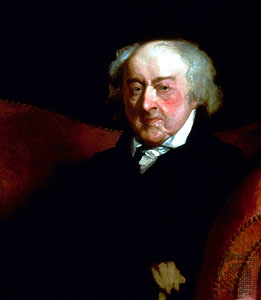
John Adams in his last painting done in 1825...1735-1826


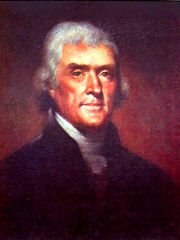
Jefferson in 1809....1743-1826


Dr. Benjamin Rush 1745-1813


On a ungodly hot and sunny July 4th 2005....... I stood at the grave of Dr. Benjamin Rush... I wanted to be there and say thank you to a man who made such a difference in the world and in our lives.

He is known as the father of modern Phychology...But he was also the catalyst in bringing together Adams and Jefferson who had not spoken in near a decade....

He wrote a most unusual letter to John Adams on October 16, 1809. This letter was not only remarkable for what it suggests..but what it says of Adams and Jefferson at the end of their lives is most remarkable. The letter is long and I will use most of it.


The letter was the result of a dream Dr Rush had....

It starts like this.............


Philadelphia, October 16, 1809


"What book is that in your hands?" said I to my son Richard a few nights ago in a dream. "It is a history of the United States," said he. "Shall I read a page of it to you?" ..."No, no," said I. "I believe in the truth of no history but of that which is contained in the Old and New Testaments."..."But sir," said my son, "this page relates to your friend Mr. Adams." .."Let me see it then," said I. I read it with great pleasure and herewith send you a copy of it.

"1809"

"Among the most extraordinary events of this year was the renewal of the friendship and intercourse between Mr. John Adams and Mr. Jefferson, the two ex Presidents of the United States.
They met for the first time in the Congress of 1775. Their Principles of liberty, their ardent attachment to their country, and their views of the importance and probable issue of the struggle with Great Britain in which they were engaged being exactly the same, they were strongly attracted to each other and became personal as well as political friends.

A difference of opinion upon the subject and issue of the French Revolution separated them during the years in which that great event interested and divided the American people.
The predominance of the party which favored the French cause threw Mr. Adams out of the chair of the United States in the year 1800 and placed Mr. Jefferson there in his stead.
The former retired with resignation and dignity to his seat at Quincy.
The latter resigned the chair of the United States in the year 1808, sick of the cares and disgusted with the intrigues of public life, and retired to his seat at Monticello.

In the month of November 1809 Mr Adams addressed a short letter to his friend Mr. Jefferson in which he congratulated him upon his escape to the shades of retirement and domestic happiness, and concluded it with assurances of his regard and good wishes for his welfare.
This letter did great honor to Mr. Adams. It discovered a magnanimity known only to great minds.
Mr. Jefferson replied to this letter and reciprocated expressions of regard and esteem.

These letters were followed by a correspondence of several years, in which they mutually reviewed the scenes of business in which they had been engaged, and candidly acknowledged to each other all the errors of opinion and conduct into which they had fallen during the time they filled the same station in the service of their country.
Many precious aphorisms, the result of observations, experience, and profound reflection, it is said, are contained in these letters.

It is to be hoped the world will be favored with a sight of them when they can neither injure nor displease any persons or families whose ancestors follies or crimes were mentioned in them.

These gentlemen sunk into the grave nearly at the same time, full of years and rich in the gratitude and praises of their country."


If anyone can be said to have had the gift of prophecy...It is Dr. Benjamin Rush.


There is only one thing he was wrong on...ONLY ONE THING!!!!! Their relationship was restored in 1812, not 1809. If I had not known that Benjamin Rush died in 1813, I would think he would have written the letter in 1826.

But he wrote it to his friend, John Adams who he loved as he did Thomas Jefferson.

Adams said of Jefferson " I love Jefferson, I always have loved Jefferson." That was all Jefferson needed to hear...

In 1812 John Adams wrote a letter to Thomas Jefferson saying much of what Rush had said he would. Jefferson replied in kind.

By 1813 they had repaired the friendship, as soon as that had happened they both received the terrible news that their dear friend Rush was dead.

They wrote on everything, and shared, forgave, questioned, and gave the world a gift in their letters that are considered some of the greatest writings in the English language.

They did indeed fall into their graves at nearly the same time...Dying within hours of each other on July 4, 1826. Full of years and looked on with gratitude by a country who loved them.

When the years had passed the letters were seen by the public and are ever so treasured.


So as I stood at the grave of Benjamin Rush on that hot burning Sunday.. July 4, 2005.....I said thank you. Your gift and love of two great men gave a gift to man that can hardly be measured. On July 5, 2005 I received a copy of the book of all of the letters between Jefferson and Adams...It is one of my most prized items.

All there because a friend had a dream, and the dream was a gift to us all.

John Adams...... Time to reconsider him.

March 2006


I truly believe him to be one of the most disregarded of our historic figures. Over shadowed by Jefferson who was not at all equal to Adams raw talent or bravery.

Over time the name of Adams was lost in the dusty pages of history . I find that in the last 50 years...(a short time historically) Adams has been making a comeback, and Jefferson is starting to be seen as the hypocrite he truly was.
I will do a good deal of writing on Adams as time goes on. I welcome others who wish to comment on the "Atlas of American Independence" (Jefferson's words not mine) and hope to post a tremendous amount of info on one amazing man who changed the course of the world's history.

I will admit that Adams was not a warm person to deal with at times. He was not as classy as Jefferson. He did not write as well as Jefferson. But he had guts! He had more raw passion than Jefferson..and was the powerhouse behind what happened in July of 1776.

I have a lot of respect for Jefferson, I think he was a great man. I find that Jefferson was not at all kind to Adams when it came to politics. But Jefferson was always a political animal. He and Washington even stopped talking.. He referred to Washington as "old muttenhead".

The two main political animals of that time were Alexander Hamilton and Thomas Jefferson. Both were not warm or friendly people. Both of these two guys were snobs and both of them disliked Adams who was really down to earth. Neither of those two guys were in their fields plowing, or planting crops, or doing the work...Adams was.

Jefferson who said that all men are created equal had a large amount of slaves. Nor did he free them... Adams had hired help.

Although Aaron Burr was not to likeable a person either....I like him more than Hamilton. The reasons for their duel have a lot to due with what Hamilton said of Burr...and it was really nasty.

But I think that we have bypassed Adams. I think it is time to honor the Atlas of American Independence!! Let's have a monument to him in Washington..

Monday, March 10, 2008

Garret Hobart 1844-1899 ..One of the most forgotten Vice Presidents..However, his death changed the world..A look at his grave in Patterson, NJ

President William McKinley and Vice President Garret Hobart relaxing on a vacation. They were very close and often would go on vacations together with their wife's who were also very close.

It was perhaps the nicest and warmest relationship in the Presidency. Hobart was often referred as to as the co-President. Both he and McKinley were beloved by just about everyone.
Hobart was involved in every aspect of the Presidency. McKinley made the office of the Vice-President a vital one to his administration. The main reason was he very warm relationship with the Hobart's.
Hobart was also McKinley's savings advisor. As Hobart was involved in many businesses and McKinley had once had the misfortune of having to declare bankruptcy. Therefore McKinley gave Hobart part of his paycheck as President to him to invest so he would never have such a problem again.

(Remember, ex-Presidents did not get a pension or anything from the government save for free postage.)

It was planned that Hobart would be a part of McKinley's 2nd administration. But fate had other ideas.


Hobart was strickened in mid 1899 with heart disease.
By the fall he was in pretty bad shape. McKinley wrote often from the White House and the Hobart's were writing back.
It was heartbreaking for McKinley as he was not only seeing a dear friend dying, but the one person who made his administration so happy and successful, his friend and Vice President.
The letters from William McKinley and his wife to the Hobart's are just filled with love and hope. The Letters back from the Hobart's were full of love and realism.

They knew it was only a matter of time. On November 21, 1899, Hobart died.


The entire world went into mourning for the very much loved Vice President.
Much of the Senate, Congress, Supreme Court, Cabinet, and of course his friend, the grieving President came. McKinley said it was great loss for him. He seemed very effected by it all as it was noted in the papers.

It was a grand event in Patterson, New Jersey. As all of the American and much of the world's political body came to honor Hobart. He was laid out in a Tiger Oak casket with silver handles. On the lid was a shield saying. Garret Hobart 1844-1899.


The Vice President was then laid out in City Hall in Patterson, and then the service was held in the Presbyterian Church. It was standing room only and most of the locals who knew him were sadly not able to go inside as it was over crowded with visitors.

After the service there was a march to Cedar Lawn Cemetery on the edge of town where Hobart's body was placed in the Receiving vault. President McKinley was with the body all the way to the vault and then made it his business to thank the heads of the cemetery for their work. He kept saying it was a great loss, not only to him but the country.
McKinley while there was able to see New York from the Hills of this Patterson cemetery. Then they all left and the Body rested in the receiving vault till the following year.


The inside of the old Receiving vault. The door leads to vaults to hold the caskets of those who do not have mausoleums yet or it is too cold to dig a grave. Today with tractors to dig, cold weather is usually not a great problem. but still they get their use now and then. But this is was Hobart's first resting place.


What is not really known today is that Patterson was one of the wealthiest communities in the United States at the end of the 19th century. The location of the Hobart Mausoleum is surrounded by many like it and many graves marked with very opulent funeral statuary. It is a most incredible place.
To look at it today one can only look with wonder at the grand graves and mausoleums. In this picture you will see the Hobart Mausoleum on the left and many of the other graves of that era in its locale.


This is the Hobart Mausoleum built in 1900-01. It is the largest mausoleum in the cemetery.


The name is on the front. Oddly there are no flags or markings on the structure to say who is there and who he was.


The inside of the Mausoleum. It was very hard to photograph this. I had to try several times taking pictures through the grating of the Bronze doors. It is quite lovely inside. In this structure rests Hobart, his wife and daughter.


Now comes the great change that Hobart made by his death.

History just needs a little thing to change the entire world. Hobart was to be in McKinley's second term. But by his death the political bosses were at a loss as to who to make Vice President.
Theodore Roosevelt who was at this time the Governor of New York was a real pain to all of the political bosses, but mostly Thomas Platt.
There was little love between McKinley and Roosevelt, But the bosses wanted to get rid of Roosevelt.
The best place to put him was the Vice Presidency. As it was a nothing position, at least it was now.
Senator Mark Hanna put it best to the Republican bosses saying.."You have put one life between the Presidency and that damned cowboy".

McKinley had no plans to make Roosevelt a part of his inner circle. Roosevelt had embarrassed and insulted McKinley many times in the press. Saying when it came to war, McKinley had the backbone of a Chocolate eclair.
The thing that Roosevelt failed to grasp was that McKinley knew war, Roosevelt had his fantasies of what it was.
Also McKinley had more class than Roosevelt. But that did not stop Roosevelt from making a fool of himself and once again embarrassing the President. But McKinley when told that Roosevelt would be his running mate was as kind as he always was. He was like a kid in a candy shop. He was shocked when he saw McKinley's modest home in Canton. Roosevelt could not have that, he was as Harry S. Truman put it. More bull than moose. I am sure that McKinley's scotch consumption went up, knowing that he had Roosevelt with him for 4 years. But once again fate laid out its icy hand.

In September, 1901 McKinley was assassinated and Roosevelt was President. If Hobart had lived how different the history of the United States may have been.

If you get the chance visit the mausoleum of Hobart. No one comes by anymore, nor does anyone know who he was, or what he was, which is sad and what prompted me to write this.

I was glad to drop and wish the former Vice President well, and to ask him to give my best to his friend President McKinley as well.


McKinley and his running mate. There are very few of them together.

Thursday, February 28, 2008

Traveling through Putrajaya, Milaysia Feb 20, 2008


Here I am sailing down by many Government buildings and bridges in PutraJaya, Milaysia. Milaysia is in many respects a rather new country. It was once a colony of the British Empire. But in August of 1957 it became its own country. It was interesting to see the country and many of its small towns and villages. I look forward to seeing it again. Milaysia is a country that is growing fast. In the next 25 years we will be seeing a lot about this country and the industry and influence it will have on the world. I have not been writing too much here for the last month. First off since I was away...Now I am back and ready to write a lot more about history.