Tuesday, August 20, 2013

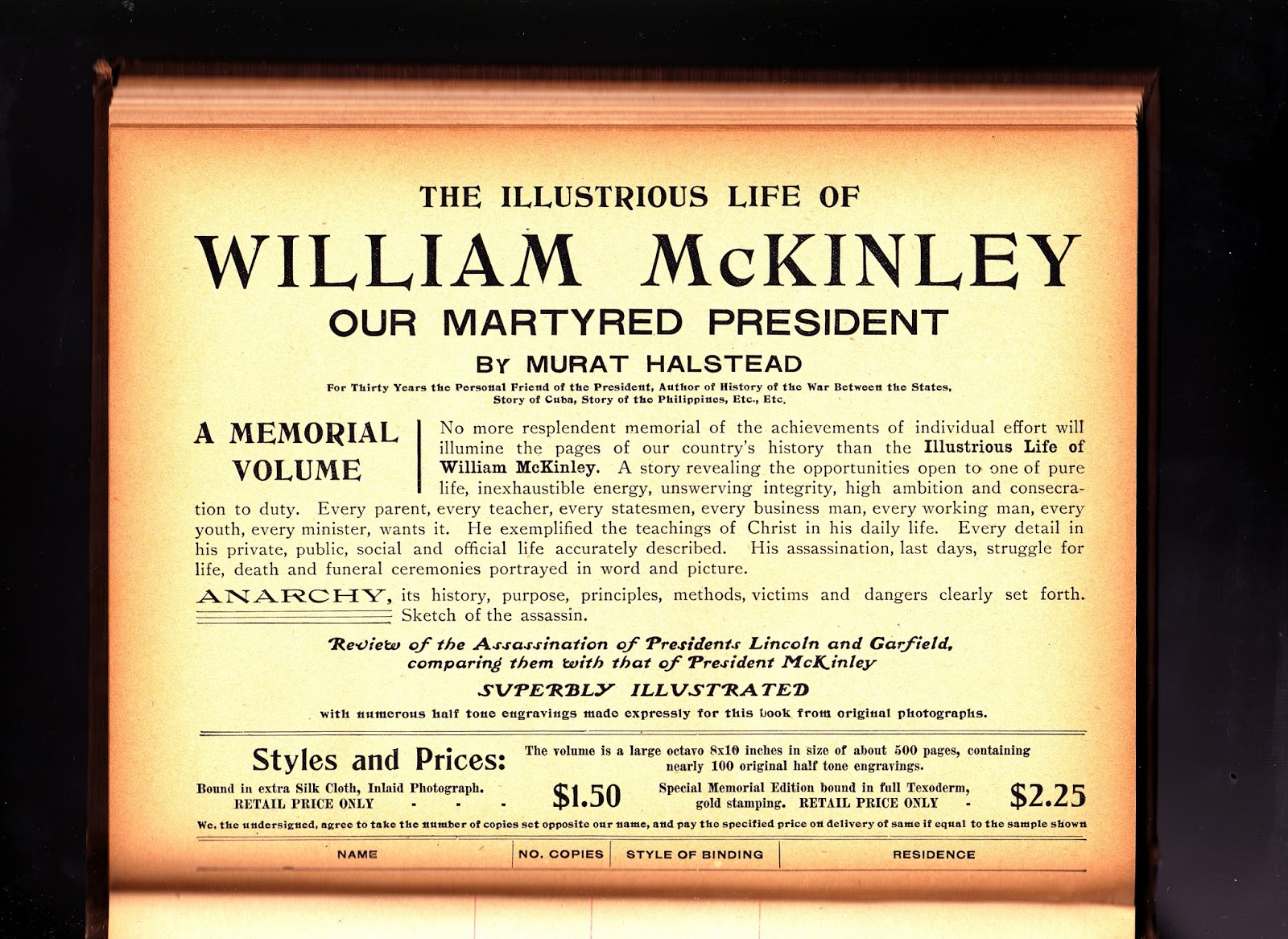
The sales book for the McKinley assassination memorial book.. Late September 1901


In mid September 1901. The 25th President of the United States died from the effects of an assassins bullet. As soon as the funeral was into swing there were memorial books on the planning board. There would have been several hundred of these thin sales books printed. The book was still being formulated a week after the assassination but, it was in the works. So this book and books like it were brought door to door by hundreds of sales people, The final finished book was a big seller and of course this door to door campaign was quite successful.

One must remember it was dealing with an assassination of the president. But if you were over 42 years of age at this time you would have seen this as the third assassination of a president in just 36 years! For there had been two before McKinley and they were in a rather close time period.  Lincoln in 1865, Garfield in 1881 and then McKinley in 1901.

So this book would be filled with not only a story about McKinley. But it was filled with Victorian styled grief and overkill. In one of the illustrations it has McKinley being brought into the "Hall of Martyrs" in Heaven. But this book would sell well as McKinley was so universally grieved for.It is odd that he is so little remembered today, considering his popularity then.


Of course it had instructions to sales agents


An example of the title page and a few chapters to give a certain gist to the book that was to be.


Showing who else had been shot and killed in the last 36 years.


The assassin


Lastly, the order form


Wednesday, August 14, 2013

The first commercial recordings of birds... Bremen, Germany 1910


In 1910 the German branch of the Gramophone Company made a series of unique recordings at the Aviary of Karl Reich in Bremen. This was a very adventurous jump in the field of acoustic recording. For in this case the recordings were made onto wax masters that could not be stopped or started once the recording began. Everything was done on a single take. Just the thought of that makes it so remarkable. But the Gramophone Company was not there to record one of the canaries of the operatic stage, They were there to record the voices of birds! These first recordings were on red seal records.


The Nightingale recording was done first. In fact there were several Nightingale recordings made. Some with great results and of course a few that were problematic. Of course these birds were remarkably loud and sang a lot. It is interesting as you listen to the recording made over 100 years ago you can hear the bird bouncing around in it's cage. 


The Gramophone Company which had just changed it's name back from being the Gramophone and Typewriter Company was rightly proud of these recordings made by it's German branch and by the recording engineer Max Hampe. The process was explained in literature put out by the Gramophone Company and also by it's sister companies in other parts of Europe and in the United States. The pressings shown here are from the pressings by the Victor Talking Machine Company in the 1913-15 period. In it's description of the recording process a cage was placed directly before the recording horn and the bird was allowed to sing. It was quite amazing how much the birds did sing. The recordings were an acoustical triumph. They are remarkably lifelike and are stilled used in digital form on some bird sites. 

The following recordings were made in the 1910 to 1912 period.  They would be pressed in much of Europe till 1914 and in the United States till 1916. During the war anything German was banned. But these wonderful recordings were re-released by 1920. These recordings were the first and are still highly regarded in the field of bird song recordings. Who would have thought that one hundred and three years ago.


 A 1913 pressing of the 1910 original and first recording of captive Nightingale. These recordings were remarkable. But quite understandably were not massive sellers. Today they are quite rare. Putting the bird on a red seal record was an odd choice. This label was used for the most famous opera singers and classical instrumentalists. But for a while this Nightingale from Bremen, Germany was one of the great stars on red seal records. The Nightingale was in the company of Caruso, Tetrazzini, Melba and other singers that many would call canaries.


In this adventurous recording there is a duet. Two birds in front of a recording horn from the 1910-1912 period. All of these blue labeled Victor recordings were pressed in the 1913-15 period..Rather than being on the Red Seal the other birds were on blue label records. in which all would be in time. But this is an example of an early 1913-15 style label.


Here is the lovely song of a Sprosser (also known as a field Nightingale)


The second recording of a Nightingale made in 1910.


Lastly the song of a Thrush. Recorded in the 1910 -1912 period. Recorded before the World Wars and the dreadful destruction of the of the age in which these recordings were made.  A rare and unique series of recordings.

Friday, August 02, 2013

Deaths on August 2, 1921, 1922, 1923. Three major deaths on the same day over three years.


August the second is a day in the minds of those who are into opera, invention, and the American Presidency. For on that date in three consecutive years died one from each of these categories. I found it rather interesting that each of these individuals were very prominent in the field they represented. Since I am very interested in all three fields I am interested in each of them.


In Naples, Italy on August 2, 1921 died the greatest voice of a generation. The great operatic tenor Enrico Caruso.


In Canada on August 2, 1922 died one of the great inventors of the age. The inventor of the telephone Alexander Graham Bell.


In San Francisco, California  on August 2, 1923, Warren G. Harding the 29th President of the United States died


They always say things come in three's.  From 1921 to 1923 on August the second they sure did.

Sunday, July 28, 2013

How computers have changed in my lifetime.


I have lived long enough now to say that I remember the saying that "computers are the future for man". Of course, that was being said in the late 1950's and 1960's. I never saw a real computer till the World's Fair in New York in 1964-65. Most probably it was not a real computer, just operational to fit the demonstration that was going on for the fair. But at the fair I learned what computers would do for us. I am still waiting for computers to do some of what was said at the fair.

1. clean the house
2. drive a car
3. start the dinner at home
4. run the household
5. take care of all the bills
6. call you on the phone
7. be an entertainment center

That was just a few of the things I remember at the fair, as to computers. Of course my only understanding of computers at that time circa 1965 was things like Robbie the Robot, Batman, Time Tunnel, and other movies and TV shows.  Also lots of toys being made in Japan of all kinds of robots and phony computer activated devices.

I really kind of thought the same of robots and computers. They seemed the same..They were from the future.  I was looking forward to computers and robots driving and cleaning. I remember at the World's Fair there was an exhibit that had a car driving itself and that gave the ladies in the car more time to relax and smoke. It was a different age!

The closest I came to robots was in 1969 in Ft. Lauderdale Florida in which a A&P store was retrofitted with automatic devices to make shopping easier and it led to a massive disaster at the store which I wrote about several years ago.

I saw my first computer in High School. It was the size of a large room. Also it really did nothing much except punch some of those silly computer punch cards. My school was very excited  All of our special cards for teachers to sign came from that computer. So it had holes all over where people needed to write.

In the late 1960's and early 1970's the reel to reel type of computer taped machines really made a splash and many companies used them. I remember working for a few few companies that had them. all the blinking lights in front that did nothing, just were there. This I learned from a repairman,  to let people know it was doing something. We had all looked at the lights in the computers on TV and were amazed by the lights that flashed on and off and I was rather let down by that info.

I worked for a company in 1979 that had two massive consoles and two massive computers connected to the consoles by many wires. Each time we needed to change any info we needed to change the reel. Connected to the computers were massive printers to make the spreadsheets and they noisily typed out like a typewriter all the information. The papers always got jammed in these copiers. The whole thing was huge, ineffective, gave off a lot of heat, and was extremely temperamental;.

The personal computer made its splash in the late 1970's using cassette tapes. They were not much more than a toy. But in 1982 the IBM personal computer made its first appearance. It was not too fast to gain ground as there was not too much to do with them. Of the two models there was one with a hard drive (IBM AT) and another that just used floppy discs (IBM XP).

I was very lucky at the dawn of the computer age to get a job at a research laboratory under the unique and brilliant eye of Dr.Gopinath ..We all called him Gopi for short and it was a rare privilege to work under him. The fact of how I understood the idea of how a research lab worked helped later in Edison research.

Gopi ordered a 20 IBM computers in his quest for artificial intelligence. When Gopi saw me looking at these new and  rather small computers he said to me "Jack start playing with them, have some fun"  So I turned on an IBM AT computer and it slowly came up and the monitor came on and was in color. It was so amazingly basic, but to me that day it was like entering a new world. I had a wonderful time working at Gopi's lab and I was there a long time till funding was reduced.

Before long there was a IBM AT Plus and more computers came into the fray. In the mid 1980's, we had an early form of internet at Bellcore where I was working and we could send rather quick communications to other workers in the building. Of course this was early on and we were programming using VI and C. We also had huge Sun Microsystem computers. that could give you separate windows. Which was an amazing feature.

By the late 1980's I was working for a computer store and repair place. It was called Microage Computers and this was the age of the networks and servers. I did simple repairs on the rather simple computers. The fanciest machine at this time was the Compaq 286. In fact I was at the party for the announcement of the newest and most advanced computer ever at the time. The Compaq 386.

It was at this time I got out of the computer field.

Now 25 years alter I am writing this on a computer I would never have dreamed of then. On to an internet that was not even dreamed of either. The computer has become a part of our lives. Now we have smart phones that are little computers and much more that I really do not understand.

Once I was on the cutting edge of this technology, now I see things that are beyond my wildest dreams. What will be the next giant step? I am amazed and I remember where it all began. My hasn't it been amazing!


Those of us who were in this first generation of computers saw the beginnings of a whole new world.


Monday, July 22, 2013

The railroading of Captain Turner of the Lusitania


Captain Turner was in charge of the Lusitania in May of 1915. This was his misfortune. Although he was prudent and well admired captain. He was railroaded by the none other than Winston Churchill and the Admiralty.The more one really knows Churchill, the more really sees who he was really was.

 The poor captain was used as pawn and allowed to be destroyed. The war that was fought from 1914 till 1918 was the war to continue all wars. Certainly not to end them. Churchill always welcomed wars and I am really of a belief that there was a genuine desire to see the Lusitania sunk. Churchill wanted the United States in the war very badly and he was hoping some sinking like this would help. Germany was not really the enemy of England, although England felt threatened by Germany's rise to power. It was all due to keeping England on top. The war was a war about nothing. The war that would forever change the world and ruin much of the future.
How many lives were lost and how many destroyed for this dreadful event that was the blame of both England and Germany. The world of warfare and plain decency in government was railroaded by the Admiralty in 1915. Sadly Churchill would be up to his same tricks later.


Captain Turner you were a great man who was allowed to be destroyed for another's profit.

Sunday, June 30, 2013

The end of the road for two old patriots in 1826.....John Adams and Thomas Jefferson.


By the end of June in the year 1826, there were two very old men on the verge of death. One was named John Adams and the other Thomas Jefferson.

 Adams was always the more healthy and robust of the two. Though even now as Adams was nearly 91 years of age he was aware of all around him. He was read to as was his pleasure. He met some old friends and young folks who were wishing to touch a piece of history. He lived in a calm loving atmosphere, surrounded by his family save for his son John Quincy, who was President of the United States.

In contrast, there was Jefferson. He had for the last year suffered from many internal problems and much arthritis. His keen mind was not as clear as it had been, and his household or what was left of it was in great need of repair. The truth was that Jefferson was broke, he had been for many years and now as his life started to fade into the darkness. He was truly at an end. A lottery had been organized to try to help Jefferson out of his dreadful financial distress. But that stress at 83 was as deadly for him as the rest of his infirmities. His slaves were there to look after him. His mistress who he owned, Sally Hemmings was there. One would wonder if because of love, or because he owned her. The children produced by them were still slaves at this moment. They would be freed at his death.

As these men faced the last few days of life, what thoughts were going through their minds. I am sure Jefferson was thinking of his greatest moment when he took John Adams advice and wrote the first draft declaration. It was a continuation of the declaration written the year before by Adams in 1775.

I am sure each thought of Franklin, seeing him in their own view of his actions. Remembering Washington fondly, or not too fondly as Jefferson was not a great fan of him. Adams I gather thought of Washington, and perhaps had one last jealous urge to set the record straight. Feeling that Jefferson's writings on the revolution would be followed more than his own of which he felt he had been more honest.

Perhaps Jefferson finally had remorse in what he had done to many people. His actions and his back stabbing was remembered by many and perhaps now as he lay in his bed and breathed with some difficulty he thought of Aaron Burr and what he had done to him, or perhaps to his old friend John Adams.

Each was invited to Washington DC, or Washington City as it was then called, but it was an impossibility for either to venture far from their chair or bed.

Each man knew in late June that the glorious 4th of July would be the 50th anniversary of the great Declaration. Although as each man knew it was actually declared and voted on July 2nd. But even the stubborn Adams had finally given up on the 2nd and now was waiting and striving to live to see the glorious day.

Adams went about his life as usual, although weak, he showed no signs of dying in these last few days of June. But for Jefferson he was already on the way, It was not really certain he would make it.

By July 3rd Jefferson was in his deathbed and delirious, he asked his slaves several times if it was the 4th..

Adams spent much of the day in his beloved library, surrounded by his books and his imagination that went soaring past the Milky Way as he liked to put it.

The 4th came, and the sun rose on to Jefferson and Adams at the same time. It was their day, it was to be for both their last day of life.

Jefferson was in and out of consciousness and did learn it was the 4th and he allowed himself to die.  Adams started his day like all the others he had in these last years. A little breakfast and he was carried up to his library where he would spend his day. One can only imagine what went though his mind in the last morning. But I am sure he took more than one trip beyond the Milky Way.

In the early afternoon he was taken ill in the chair in which he was sitting by the window of his library...If death was to find him ....It was there.

On July 4, 1826, the two major writers of the declaration of independence died .. It was it's 50th anniversary.

An Amazing moment of history.

Sunday, June 02, 2013

Putting Francesco Tamagno at the right speed on his Gramophone and Typewriter records.

                    A 1904 Victor pressing of one of Tamagno's records.


I recall as a kid I had an LP of great singers of the past. It had a number of singers on G&T records singing. Tamagno sounded so ridiculous on this record. Caruso sounded like a little boy and a few others sounded rather strange. The fact is that they played those original records at 78 RPM and transcribed them to the LP at that speed.  The album of mine made by RCA just took it for granted that a 78 record played at 78. Well few did! The sad part of the early years of recording is that 78 was an objective, or a suggestion as to a speed to use. Most recordings made from 1900 to 1925 fail to be at this speed. What is worse the really early days 1900-1905 find records going from 64 to 82 RPM's often. There was no true regulation. Even recording engineers felt that certain speeds were good for certain singers!  I have found a large number of G&T recordings hovering around the upper 60's and rarely are they at 78.

This has caused a lot of problems for historians, music lovers, and those who wish to allow new generations to hear the voices from the past. By 1926 the speed issue was pretty well handled and all electric phonographs had the speed of 78 factored in it. But what of the earlier recordings? Many forgot that there was a great discrepancy in speeds, so by the 1950's when LP records came into forefront and there were lots of reissues of these early recordings, sadly played at 78.

Play a recording of Caruso at 85RPM and it sounds stupid and not correct. But play it at 75RPM where most of his recordings were made at and it sounds natural.  The same can be said of Tamagno. For ages we have played his records at 78 RPM and they sound laughable. But at a proper speed  his voice sounds as it should.

 Listen to the recordings were he does a spoken introduction and see where it sounds right. Plus we need to remember that he was not in the best of health when these recordings were made. So instead of trying to pitch these recordings to a certain piece of music we must remember he pitched many of the pieces down. Nothing unusual about that, Caruso did it with several of his recordings as well.

We have learned over the years that Caruso's early G&T's play at 67RPM. Suddenly he sounds correct and not causing everyone to wonder how did his voice change so.  With Tamagno's recordings I listened and used several factors.

1. All the music was pitched down at his request

2. The pianist for the recordings was Landon Ronald, who was very adept at changing keys.

3. They were recorded by the same people who did the Caruso recordings

As I played the records keeping all of the issues in mind I found that Tamagno's voice sound reedy and weird at 78 RPM. If I brought it down to around 68 RPM  his voice sounded amazing and rich. Keeping in mind that he was singing at a lower key and was in rather ill health. He would die in 1905

I brought some people over to the house and played the records at this speed and people were amazed at the sound of the voice and how natural it sounded. Not every recording was done at the same time and there are variations. But the major bulk of the 1903 sessions seem to me to be very good and make sense around the speed of 68 to 70 RPM's

I found his voice to be very attractive, and pleasant to listen to. Not like that RCA recording I had as a kid in which I could hear him singing ever so shrill. Through this I have found a new admiration of his voice and the quality of his singing.

I was reading an article saying that many think that his records should be played at 77 RPM. Some said 73RPM. I truly believe it is the slower speed I found, that shows off his amazing voice to it's best advantage.

So I enjoy his singing now at what I believe is close to the proper speed.

Saturday, June 01, 2013

TANK MAN ..The man who changed the world.


I have asked for years who this brave man was?  No one knows, nor will we ever know. He is as unknown as anyone from a distant past. But, he is not from the distant past. These images are from 1989!

This young man who was probably far younger than I changed the world by simply saying to a gathering of tanks.......ENOUGH!!!!!

 But both the man with his shopping bags, and the man in charge of this tank are unique parts to this story.

The China of 1989 is not existent anymore. Much due to the image of this man. Who was willing to stop not only a tank, but a squadron of them. Saying most probably, get out of my city. This image has inspired people all over the world, except China. Where it is still not very well known.

The riots in Tienanmen Square shook the world to it's very core. The results of the riots have changed China and improved it greatly.

I showed this photo to a Chinese Graduate from Beijing University in 2007 who had just arrived in the United States. He had never seen it before and was inclined to think it was a fabrication. This is how well this iconic image has been cloaked by the Chinese Government.

This image gave strength to the East Germans and to the Russian people as they faced down the crumbling communist government. While no one knew his name, or if he was alive was there with them. The spirit of Tank Man walks with us all. He faced the greatest force and stood up to it all. He is the inspiration of the word change.

To see how many tanks he was holding up see the image below.


One has to say something about the tank commander. He did not run over the young man, he did not try to shoot him, and he tried to get around him. When he saw that he could not, he shut off the tanks motor.

There are just a few images of this brave young, unknown man. There is no information on the tank commander either.  All is lost to us. In a way both are heroes in their own way.

I always dreamed that by the 25th anniversary of this massive riot, we would know who he was. But today this man who walked among us and did what none of us could is lost to us in history.   He was young, far younger than me I am sure at that time.

I often think of this young man and who he was.  He was probably a common man who had done a days work and saw this advance of the tanks. He had his shopping with him, he had no plans to stop the tank. But at a certain moment he rose beyond the ranks of a mere mortal and faced the greatest challenge. Who of us will ever be so noble or far advanced to do such a thing. He had no idea he was being filmed. The only film of him was stored in a toilet tank to hide it from the Chinese authorities.

This tells us one thing. There are many Tank Men and there will be many more.

But, this brave young man's image will be known when tanks are obsolete. When the communist government of China is no more and will inspire others to show that one person can make a difference.

To who ever you are, Tank Man, you have inspired me in ways I cannot put into words. You have changed a world and moved it forever forward.. More than you ever dreamed!


Thank you.