Tuesday, August 27, 2013

Report of the commission on the renovation of the Executive Mansion. Official report published by the Government Printing Office in late 1952.


Between the years 1948 and 1952 there was a massive restoration of the White House. In many ways of thinking it was more a total destruction of the building (save the walls) than a restoration or renovation.

The entire building was gutted and rebuilt with a steel inter structure as used in all modern buildings. The White House today is a modern building that has little relationship with it's great history.

The only thing that really is original structurally save for a few items inside is the outside walls. This report is on the destruction and rebuilding of the White House. So the word renovation, although in the minds of many means to restore. In this case it means rebuild.

The definition of the word renovation...

Definition of RENOVATE

1
: to restore to a former better state (as by cleaning, repairing, or rebuilding)


The term fits. But most people are not aware that the White House is really a new structure.


 Although this project was done a little over 60 years ago, the methods used today are 180 degrees different than what was used then. For today we try to preserve what is original, rather than just tear everything down.


This report goes through everything


In this copy I have there is a mimeograph copy of the letter sent to the Secretary of the Army with regards and requests to have this book for his personal library and to give out some others to various other officials.


The cornerstone of the "new"White House.   Which was built in the 1948-52 period, not restored.

Monday, August 26, 2013

Indentured Servant document from 1681


Here is a rather rare and unusual document from February of 1681. It is a document of indenture. Basically becoming a slave for a period of years. This document is long and detailed and I could not copy all of it. But, here is a much of it and the signatures on the back of this velum document.

So just a unique piece from well over 330 years ago.


 Indenture says it all doesn't it?


On the top of the picture above  you will see the writing of the date. Written in a script and in a very long form.


 I wonder what ever happened to the servant who was here signing much of his life away long ago.

Thursday, August 22, 2013

The very rare sleeve for Marconi Velvet Tone Records. 1907-08


Now many in the record collecting world are quite familiar with the famous and to a degree infamous Marconi Velvet Tone Record. Which was introduced by Columbia in 1907. It was a very well made record that was not only unbreakable, but also flexible. In an age of easily broken 78 RPM recordings it seemed to be a great answer to the problem.

 However, it was not. It was an advanced recording that was produced with just mediocre pressings of existing Columbia records. One of the recordings I have has an announcement! Announcements were discontinued in 1903! This gives an idea of what was being put on these records. Some good stuff, but also some rather old and out of date recordings as well.

 By 1908 they were gone. They were too ahead of their time and the needles needed to play them caused them the greatest pain. Cause you could not remove them from your phonograph till it was worn out. So it required you to play only Marconi records or regular records. You could not mix. This was one of their great problems.and soon they were dropped. 

However, there was a short number tried in the South American market in 1908 in double disc format. These are quite rare today. 

 But nothing is more uncommon than the original sleeves for these records. The sleeves were made of a heavy cardboard and had a thin cellophane window in the place for the record label. Some what reminiscent of Victor's and G&T's celebrity record sleeves of the 1903-1905 period. They had a picture of Marconi and info on the records. But most of all the sleeve announces to all that this invention of the Marconi record is as wonderful as wireless! 


 The regular Marconi label after they put up the picture of him with his hairpiece.(See an earlier article on these records)


 The back with all the do's and don't's of the Marconi Velvet Tone.


The quite rare record sleeve in it's original form in 1907


As you can see it was really a big thing to Columbia as these records were as wonderful as wireless.


The last straw and the South American Marconi Records in double disc form in 1908

Tuesday, August 20, 2013

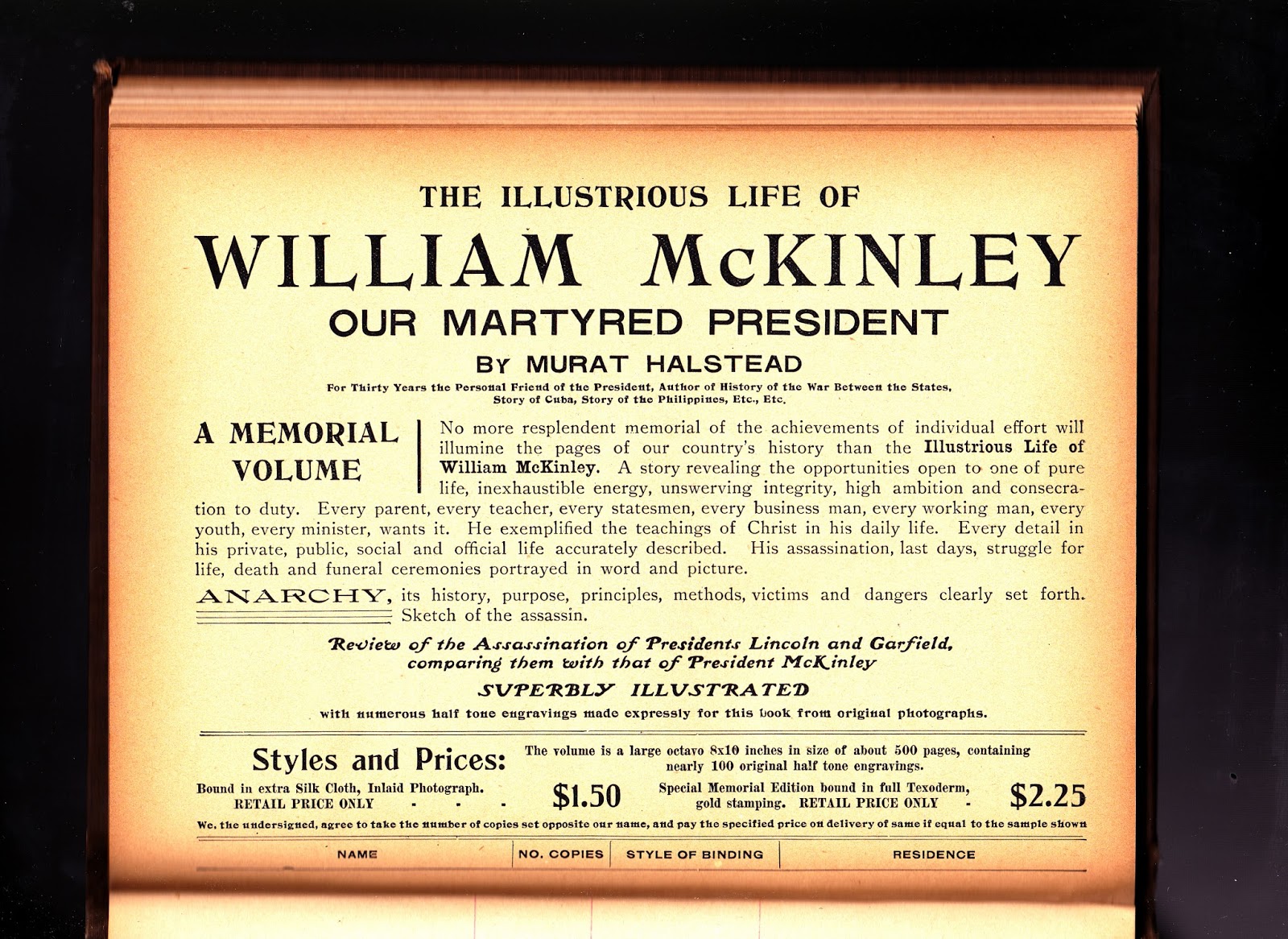
The sales book for the McKinley assassination memorial book.. Late September 1901


In mid September 1901. The 25th President of the United States died from the effects of an assassins bullet. As soon as the funeral was into swing there were memorial books on the planning board. There would have been several hundred of these thin sales books printed. The book was still being formulated a week after the assassination but, it was in the works. So this book and books like it were brought door to door by hundreds of sales people, The final finished book was a big seller and of course this door to door campaign was quite successful.

One must remember it was dealing with an assassination of the president. But if you were over 42 years of age at this time you would have seen this as the third assassination of a president in just 36 years! For there had been two before McKinley and they were in a rather close time period.  Lincoln in 1865, Garfield in 1881 and then McKinley in 1901.

So this book would be filled with not only a story about McKinley. But it was filled with Victorian styled grief and overkill. In one of the illustrations it has McKinley being brought into the "Hall of Martyrs" in Heaven. But this book would sell well as McKinley was so universally grieved for.It is odd that he is so little remembered today, considering his popularity then.


Of course it had instructions to sales agents


An example of the title page and a few chapters to give a certain gist to the book that was to be.


Showing who else had been shot and killed in the last 36 years.


The assassin


Lastly, the order form


Wednesday, August 14, 2013

The first commercial recordings of birds... Bremen, Germany 1910


In 1910 the German branch of the Gramophone Company made a series of unique recordings at the Aviary of Karl Reich in Bremen. This was a very adventurous jump in the field of acoustic recording. For in this case the recordings were made onto wax masters that could not be stopped or started once the recording began. Everything was done on a single take. Just the thought of that makes it so remarkable. But the Gramophone Company was not there to record one of the canaries of the operatic stage, They were there to record the voices of birds! These first recordings were on red seal records.


The Nightingale recording was done first. In fact there were several Nightingale recordings made. Some with great results and of course a few that were problematic. Of course these birds were remarkably loud and sang a lot. It is interesting as you listen to the recording made over 100 years ago you can hear the bird bouncing around in it's cage. 


The Gramophone Company which had just changed it's name back from being the Gramophone and Typewriter Company was rightly proud of these recordings made by it's German branch and by the recording engineer Max Hampe. The process was explained in literature put out by the Gramophone Company and also by it's sister companies in other parts of Europe and in the United States. The pressings shown here are from the pressings by the Victor Talking Machine Company in the 1913-15 period. In it's description of the recording process a cage was placed directly before the recording horn and the bird was allowed to sing. It was quite amazing how much the birds did sing. The recordings were an acoustical triumph. They are remarkably lifelike and are stilled used in digital form on some bird sites. 

The following recordings were made in the 1910 to 1912 period.  They would be pressed in much of Europe till 1914 and in the United States till 1916. During the war anything German was banned. But these wonderful recordings were re-released by 1920. These recordings were the first and are still highly regarded in the field of bird song recordings. Who would have thought that one hundred and three years ago.


 A 1913 pressing of the 1910 original and first recording of captive Nightingale. These recordings were remarkable. But quite understandably were not massive sellers. Today they are quite rare. Putting the bird on a red seal record was an odd choice. This label was used for the most famous opera singers and classical instrumentalists. But for a while this Nightingale from Bremen, Germany was one of the great stars on red seal records. The Nightingale was in the company of Caruso, Tetrazzini, Melba and other singers that many would call canaries.


In this adventurous recording there is a duet. Two birds in front of a recording horn from the 1910-1912 period. All of these blue labeled Victor recordings were pressed in the 1913-15 period..Rather than being on the Red Seal the other birds were on blue label records. in which all would be in time. But this is an example of an early 1913-15 style label.


Here is the lovely song of a Sprosser (also known as a field Nightingale)


The second recording of a Nightingale made in 1910.


Lastly the song of a Thrush. Recorded in the 1910 -1912 period. Recorded before the World Wars and the dreadful destruction of the of the age in which these recordings were made.  A rare and unique series of recordings.

Friday, August 02, 2013

Deaths on August 2, 1921, 1922, 1923. Three major deaths on the same day over three years.


August the second is a day in the minds of those who are into opera, invention, and the American Presidency. For on that date in three consecutive years died one from each of these categories. I found it rather interesting that each of these individuals were very prominent in the field they represented. Since I am very interested in all three fields I am interested in each of them.


In Naples, Italy on August 2, 1921 died the greatest voice of a generation. The great operatic tenor Enrico Caruso.


In Canada on August 2, 1922 died one of the great inventors of the age. The inventor of the telephone Alexander Graham Bell.


In San Francisco, California  on August 2, 1923, Warren G. Harding the 29th President of the United States died


They always say things come in three's.  From 1921 to 1923 on August the second they sure did.

Sunday, July 28, 2013

How computers have changed in my lifetime.


I have lived long enough now to say that I remember the saying that "computers are the future for man". Of course, that was being said in the late 1950's and 1960's. I never saw a real computer till the World's Fair in New York in 1964-65. Most probably it was not a real computer, just operational to fit the demonstration that was going on for the fair. But at the fair I learned what computers would do for us. I am still waiting for computers to do some of what was said at the fair.

1. clean the house
2. drive a car
3. start the dinner at home
4. run the household
5. take care of all the bills
6. call you on the phone
7. be an entertainment center

That was just a few of the things I remember at the fair, as to computers. Of course my only understanding of computers at that time circa 1965 was things like Robbie the Robot, Batman, Time Tunnel, and other movies and TV shows.  Also lots of toys being made in Japan of all kinds of robots and phony computer activated devices.

I really kind of thought the same of robots and computers. They seemed the same..They were from the future.  I was looking forward to computers and robots driving and cleaning. I remember at the World's Fair there was an exhibit that had a car driving itself and that gave the ladies in the car more time to relax and smoke. It was a different age!

The closest I came to robots was in 1969 in Ft. Lauderdale Florida in which a A&P store was retrofitted with automatic devices to make shopping easier and it led to a massive disaster at the store which I wrote about several years ago.

I saw my first computer in High School. It was the size of a large room. Also it really did nothing much except punch some of those silly computer punch cards. My school was very excited  All of our special cards for teachers to sign came from that computer. So it had holes all over where people needed to write.

In the late 1960's and early 1970's the reel to reel type of computer taped machines really made a splash and many companies used them. I remember working for a few few companies that had them. all the blinking lights in front that did nothing, just were there. This I learned from a repairman,  to let people know it was doing something. We had all looked at the lights in the computers on TV and were amazed by the lights that flashed on and off and I was rather let down by that info.

I worked for a company in 1979 that had two massive consoles and two massive computers connected to the consoles by many wires. Each time we needed to change any info we needed to change the reel. Connected to the computers were massive printers to make the spreadsheets and they noisily typed out like a typewriter all the information. The papers always got jammed in these copiers. The whole thing was huge, ineffective, gave off a lot of heat, and was extremely temperamental;.

The personal computer made its splash in the late 1970's using cassette tapes. They were not much more than a toy. But in 1982 the IBM personal computer made its first appearance. It was not too fast to gain ground as there was not too much to do with them. Of the two models there was one with a hard drive (IBM AT) and another that just used floppy discs (IBM XP).

I was very lucky at the dawn of the computer age to get a job at a research laboratory under the unique and brilliant eye of Dr.Gopinath ..We all called him Gopi for short and it was a rare privilege to work under him. The fact of how I understood the idea of how a research lab worked helped later in Edison research.

Gopi ordered a 20 IBM computers in his quest for artificial intelligence. When Gopi saw me looking at these new and  rather small computers he said to me "Jack start playing with them, have some fun"  So I turned on an IBM AT computer and it slowly came up and the monitor came on and was in color. It was so amazingly basic, but to me that day it was like entering a new world. I had a wonderful time working at Gopi's lab and I was there a long time till funding was reduced.

Before long there was a IBM AT Plus and more computers came into the fray. In the mid 1980's, we had an early form of internet at Bellcore where I was working and we could send rather quick communications to other workers in the building. Of course this was early on and we were programming using VI and C. We also had huge Sun Microsystem computers. that could give you separate windows. Which was an amazing feature.

By the late 1980's I was working for a computer store and repair place. It was called Microage Computers and this was the age of the networks and servers. I did simple repairs on the rather simple computers. The fanciest machine at this time was the Compaq 286. In fact I was at the party for the announcement of the newest and most advanced computer ever at the time. The Compaq 386.

It was at this time I got out of the computer field.

Now 25 years alter I am writing this on a computer I would never have dreamed of then. On to an internet that was not even dreamed of either. The computer has become a part of our lives. Now we have smart phones that are little computers and much more that I really do not understand.

Once I was on the cutting edge of this technology, now I see things that are beyond my wildest dreams. What will be the next giant step? I am amazed and I remember where it all began. My hasn't it been amazing!


Those of us who were in this first generation of computers saw the beginnings of a whole new world.


Monday, July 22, 2013

The railroading of Captain Turner of the Lusitania


Captain Turner was in charge of the Lusitania in May of 1915. This was his misfortune. Although he was prudent and well admired captain. He was railroaded by the none other than Winston Churchill and the Admiralty.The more one really knows Churchill, the more really sees who he was really was.

 The poor captain was used as pawn and allowed to be destroyed. The war that was fought from 1914 till 1918 was the war to continue all wars. Certainly not to end them. Churchill always welcomed wars and I am really of a belief that there was a genuine desire to see the Lusitania sunk. Churchill wanted the United States in the war very badly and he was hoping some sinking like this would help. Germany was not really the enemy of England, although England felt threatened by Germany's rise to power. It was all due to keeping England on top. The war was a war about nothing. The war that would forever change the world and ruin much of the future.
How many lives were lost and how many destroyed for this dreadful event that was the blame of both England and Germany. The world of warfare and plain decency in government was railroaded by the Admiralty in 1915. Sadly Churchill would be up to his same tricks later.


Captain Turner you were a great man who was allowed to be destroyed for another's profit.